
Conifer Leaf
This is a type of leaf that is mostly needle or scale leaved. The picture is one of an evergreen tree. As you can see the leaves each hold hundreds of little needle-leaved, creating a branch of the tree. These types of leaves stay green through-out every season, never turning brown or changing color like most trees, during the different seasons.

A Fleshy Fruit With Seeds
Tomato is a fruit that contains seeds inside, these seeds are used to make more plants of their own kind. There are lots of different types of
tomatoes such as plum, cherry, vine, grape, and red round tomatoes. This type is on a vine tomato, as you can see in the picture. The tomato is attached by a thin vine, to the plant, which is then in a pot, in my family's garden.

Angiosperm
This kind of plant, can flower and also bear fruits. The reason it can do both of these things is that, it holds the seeds of the plant inside the plant's ovary.

Basidiomycete
This type of organism can be classified as a fungi. This picture shows that of a group of mushroom, knowing that basidiomycete are a group of sexually produced spores on a basidia, which is the the top of the mushroom right before the umbrella like top grows bigger.

Amylase
This type of enzyme takes apart starch and turns it into sugar. In the picture you see my mouth, because amylase is present in human saliva. Which helps in the process of digestion. Amylase is also present in the pancreas, because it makes amylase to be converted into glucose to makeenergy for the body.

Thorn of a Plant
Thorns are made as a modification to a plant for some sort of reason, mostly to protect them from animals. In my picture it is shows thorns belonging to a rose plant, the reason this plant has turned to use thorns, is so that animal do not eat the roses. Think about when you pick a rose and you have to be careful not to get stabbed by the thorns because they are very painful. The plant wants to keep the flower so they have adapted a way to keep them alive.

Epithelial Tissue
This type of tissue, covers the body and lines theorgans as well. Epithelial tissue also deals with the protection of the body from harmful things, secretion of oils and water from the skins glands, sensation when feeling objects, and absorption of minerals and vitamins that help the body. The picture is of my arm, showing that the epithelial tissue is my skin, it helps protect my body from the suns rays, and from harmful bacteria getting into my body and organs.

Autotroph
An autotroph is an organism that can make its own food, using light and chemical energy. Autotroph use the process of photosynthesis, to convert water, carbon dioxide into sugar for energy and food for the organism. The picture shows moss, which is growing in place of grass in my backyard. This located in a dark area surrounding the garden, usually moist. The moss is growing by itself using photosynthesis.

Gastropod
These animals are usually in the group called mollusks, which means that they have a shell covering their body. Most have a foot for crawling, and have a head with eyes and tentacles. The picture is of three different size conch shells, we got them on vacation in the bahamas. The body of the animal had already left, meaning that someone had taken it out to eat. The shell covers and protects the soft body of the animal from prey, the only to get the animal out it is to use physical force.

Annelid
These organisms have common names such as earthworm, leeches, or rag worms. The photo shows the dirt in which the earthworm would live, underneath in the soil, you would find an earthworm. They have segmented bodies, that hold their organs. Earthworms are hermaphrodites, meaning that they can reproduce asexually. They also are considereddecomposes, since they feed on rootingorganisms.
Adaptation of an Animal

Animals adapt to maintain survival in their environment, whether changing their fur type, beak style, color of fur or skin type, or shape of body parts. The picture shows a frog that has adapted its skin to blend in with the environment, so that the frog can live without being caught and eaten. This type of adaptation is called mimicry adaptation is when an animal adapts to look like a certain object, in this picture the frog is trying to look like bark.

Endotherm
This is a type of animal that can regulate their body temperature, maintaining the temperature at one constant number. They use glands to help rid their body of excess water, but in animals that have fur covering their body, they rely on panting to help rid their body of excess water since they can not sweat through glands.This is a picture of my yellow Labrador Retriever Sassy, she is 12 years old, and most days in the summer you can find her in this position. She heavily relies on panting during the summer, before researching about endotherm, I believed she was doing thisbecause of thirst, but now I understand that she is actually, trying to rid her body of water.

Frond
A frond is a plant that has divided leaves, almost making either side look identical. Usually found on ferns, the leaves of ferns are grown from the stem of the plant. This is a picture of a frond from the fern plant in my backyard, as you can see the leaves line up almost perfectly next to each other.

Carbohydrate-Fibrous
Mostly consist of green vegetables, containing minerals, vitamins, and fiber. The fiber that is found in these vegetables help the bodies digestive track, keeping it clean and healthy. These vegetables are also low in calories, and your body can never have to many of them. The picture is of a green pepper, which is considered a fibrous carbohydrate, another name for this veggie would be a bell pepper. The taste is sweet and not to spicy, like other peppers, people mostly eat these peppers when they are not fully ripe that is why they are green.

Chlorophyta
This type of biological term, can also be referred to as green algae. This is an unicellular organism, that relies on photosynthesis to survive. There is about 6,000 species of this algae in the world. In the picture that was taken at Sea Isle City, NJ. You can see that the algae has grown over all of the rocks that lead out to the water, making it very slipper to try and walk across. Chlorophyta lacks thins that land plants have so, they are classified as more of a simple organism.

Commensalism
This type of relationship is when one organism benefits from another but the that organism is unaffected. This picture shows horses that live together unaffected, but they do affect the insects that live underneath their hooves, in running around the horses move the dirt, thus moving the insects as well. A special bird called a cattle egret eats these insects for meals, if the horses did not stir the ground up releasing the insects then the egrets would not eat. So they are benefitting from the horses, with out doing harm to the actual horses.

Anther & Filament of Stamen
The stamen is the male reproductive organs of a flower, since a flower usual has both male and female parts. In the picture you see the inside of a flower, the yellow long string like organisms are called the filament, at the top of these filaments rest the anther which holds the pollen of the flower. Once the anther opens to release the pollen which is then carried by bees or wind or water to pollinate another flower to help it grow.

Deciduous Leaf
This type of leaf has one characteristic that most people can identify with is that these leaves turn colors in the fall and loose their leaves in the winter. But during the spring sometimes they spring flowers and keep their beautiful green shade all through summer. The process of them losing their leaves is called abscission. In the picture I took on of the many deciduous trees I have located around my house, that always loose their leaves in the fall, creating lots of raking to do. But they look nice once spring comes around and they blossom.

Cnidarian
This type of organism is mostly know as jelly fish. I know you are wondering why I put a picture of a turtle as the image, but what I researched about Cnidarian is that turtle eat them, so I figured you might be able to find a little bit of that in its tummy. Cnidarian organisms have over 9,000 different species all living in the water, mostly in oceans so that they can eat the coral and algae to stay alive. The jelly substance in the organism is actually non-living, but because it is between epithelial tissue, the jelly fish is alive. The "stingers" that happen to hurt you when swimming are called polyp and are actually apart of their mouth.

Insect
These animals have three main characteristics which include three pair of jointed legs, two antennas, and compound eyes. Having over a million different species makes them one of the most prominent type of animal. For reproduction these type of animals lay eggs, that have to hatch, but they must go through stages which is called molting, this basically means they are changing their skins. The picture is of a praying mantis, that I found when I went to turn on my hose, to water my mother's plants. So I took a picture thinking that it was perfect for bio. The praying mantis is an insect with over 2,200 different species of its own kind. These insects can camouflage their bodies to stay away from being eaten or harmed. As you can see in the picture the mantis is a light brown color to blend in with my houses' siding. A funnycharacteristic of these insects is that when mating the female will actually bite the head of the male off. After she has received his sperm to reproduce.


 This eastern newt is a deuterostome. This means "mouth second" unlike a protostome when the call of the animal is growing it forms the anus then the mouth. In other words the mouth comes second. Most animals with spines are formed this way.
 This is a fern. which can be categorized under, pteridophyte. A pteridophyte i s plant that does not produce flowers or seeds but reproduces through spores.

 This is an insect. It has 3 pairs of legs, is segmented into a head, thorax, and abdomen, and has 2 pairs of wings. It belongs to the small anthropod family. I did some research trying to figure out what kind of insect this is, and did not have much luck
 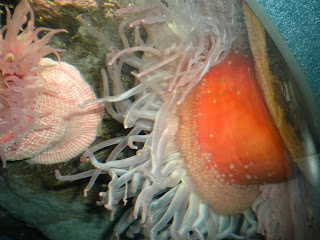 This is a cnidarian. It is a simple organism, It has an outer covering called an epidermis, and a inner gastrodermis. Its tentacles and main body have mucus-secreting pores, that give the animal a protective slimy layer.
 adaptation of a plant. This tree is actually located right next to this waterfall in Tennessee. making the soil it grows in constantly moist and soggy. This treee has adapted to its envrionment and its roots now grow very close to the surface where the soil is dryer and more sturdy.
  adaptation of a plant. This tree is actually located right next to this waterfall in Tennessee. making the soil it grows in constantly moist and soggy. This treee has adapted to its envrionment and its roots now grow very close to the surface where the soil is dryer and more sturdy.


 This eastern newt is a deuterostome. This means "mouth second" unlike a protostome when the call of the animal is growing it forms the anus then the mouth. In other words the mouth comes second. Most animals with spines are formed this way.
 This is a fern. which can be categorized under, pteridophyte. A pteridophyte i s plant that does not produce flowers or seeds but reproduces through spores.

 nectar and food through. (Top-Luna Moth and Bottom-Tuliptree Silkmoth
  nectar and food through. (Top-Luna Moth and Bottom-Tuliptree Silkmoth
  This is an insect. It has 3 pairs of legs, is segmented into a head, thorax, and abdomen, and has 2 pairs of wings. It belongs to the small anthropod family. I did some research trying to figure out what kind of insect this is, and did not have much luck
  This is a cnidarian. It is a simple organism, It has an outer covering called an epidermis, and a inner gastrodermis. Its tentacles and main body have mucus-secreting pores, that give the animal a protective slimy layer.
 Cnidarians have a diplobastic, radially symmetrical body that includes a gastrovascular cavity with a single opening that serves as both mouth and anus. Cnidarians include corals, hydras, and jellyfish, like this one that I found next to our dock.
  Arthropods have segmented bodies, hard exoskeletons and jointed appendages including, their pincers, mouthparts, legs, backfins, and antennae. Crabs and lobsters are good examples of an arthropod.
 An ectotherm is an organism that gains most of their heat from external sources, such as sitting in the sun or in the shade, like this snake I found by a pile of wood.
 An exoskeleton is a hard case deposited on an animal's surface, with each growth spurt an arthropod, like this cicada, must shed its old exoskeleton and begin to develop a new one.
 This slug is an example of a gastropod. Many gastropods have a shell that the animal can retreat into when threatened, they move by using a rippling motion, often leaving a trail of slime behind them. They also usually have a distinct head with eyes at the tips of tentacles, like this slug I found inside of our canoe.
 Lichens grow on the surfaces of rocks, rotting logs, trees, and roofs in various forms. I found this leaflike lichen on a tree outside of our house.
 An autotroph is an organism that uses energy from the oxidation of inorganic substances or the sun, like this baby spruce tree, to make organic molecules from inorganic ones.
 A female pine cone contains microscopic female gametophytes inside an ovulate cone.
 A tomato is an example of a fleshy fruit with seeds, some other examples of fleshy fruits with seeds are grapefruits, nectarines and plums.


