
This is a picture of a black bear crossing route 321 in Tennessee! I know it was amazing!! this bear is considered an endotherm. meaning warm blooded animal and all mammals are warm blooded. Warm blooded animals like ourselves regulate our own body temperature. When its hot we cool ourselves down, when its cold we use our energy to wrm ourselves up.


This is poison ivy growing up a tree. the leaves of plants have a waxy coating on their leaves to lock in moisture. This is called the cuticle layer of the plant.

 This eastern newt is a deuterostome. This means "mouth second" unlike a protostome when the call of the animal is growing it forms the anus then the mouth. In other words the mouth comes second. Most animals with spines are formed this way.
 This is a fern. which can be categorized under, pteridophyte. A pteridophyte i s plant that does not produce flowers or seeds but reproduces through spores.


 This is an insect. It has 3 pairs of legs, is segmented into a head, thorax, and abdomen, and has 2 pairs of wings. It belongs to the small anthropod family. I did some research trying to figure out what kind of insect this is, and did not have much luck
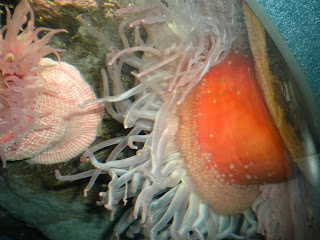 This is a cnidarian. It is a simple organism, It has an outer covering called an epidermis, and a inner gastrodermis. Its tentacles and main body have mucus-secreting pores, that give the animal a protective slimy layer.

These roots you see growing above ground are a great example of an adaptation of a plant. This tree is actually located right next to this waterfall in Tennessee. making the soil it grows in constantly moist and soggy. This treee has adapted to its envrionment and its roots now grow very close to the surface where the soil is dryer and more sturdy.
 adaptation of a plant. This tree is actually located right next to this waterfall in Tennessee. making the soil it grows in constantly moist and soggy. This treee has adapted to its envrionment and its roots now grow very close to the surface where the soil is dryer and more sturdy.
The Blue starfish near the center of the picture is an echinoderm. This id a creature that lives on the sea bottom or near the abyssal zone. Starfish have tube feet, for movement, protection as well as obtaining food which they eat with their small jaws. teir mouth is also part of there water-vascular system.

This is poison ivy growing up a tree. the leaves of plants have a waxy coating on their leaves to lock in moisture. This is called the cuticle layer of the plant.

 This eastern newt is a deuterostome. This means "mouth second" unlike a protostome when the call of the animal is growing it forms the anus then the mouth. In other words the mouth comes second. Most animals with spines are formed this way.
 This is a fern. which can be categorized under, pteridophyte. A pteridophyte i s plant that does not produce flowers or seeds but reproduces through spores.
This daddy long leg has an exoskeleton which is almost like a skeleton thats is on the outside of the body. In other animals that have exoskeltons like crabs will molt their skin and replace it with a softer shell that will over time harden.

These 2 pictures are both examples of lepidopteras. They are both scaly winged insects, and have 2 pairs of symetrical wings.
Both moths also have a coiled probiscus from which they suck nectar and food through. (Top-Luna Moth and Bottom-Tuliptree Silkmoth
Both moths also have a coiled probiscus from which they suck
 nectar and food through. (Top-Luna Moth and Bottom-Tuliptree Silkmoth
  This is an insect. It has 3 pairs of legs, is segmented into a head, thorax, and abdomen, and has 2 pairs of wings. It belongs to the small anthropod family. I did some research trying to figure out what kind of insect this is, and did not have much luck
  This is a cnidarian. It is a simple organism, It has an outer covering called an epidermis, and a inner gastrodermis. Its tentacles and main body have mucus-secreting pores, that give the animal a protective slimy layer.
p.s. I do realize some of this pictures do not have my fingernail in them. I just got back from vacation in TN for a week and we took a trip to the aquarium as well as went hiking up mountains to visit the local waterfalls. Everytime I saw something I thought could be useful for my project i snapped a picture. Unfortunately Heather was a little excited and forgot her nail in the picture but i do have witnesses as well as all of these pictures on my camera if you would like to see them.


 Cnidarians have a diplobastic, radially symmetrical body that includes a gastrovascular cavity with a single opening that serves as both mouth and anus. Cnidarians include corals, hydras, and jellyfish, like this one that I found next to our dock.
  Arthropods have segmented bodies, hard exoskeletons and jointed appendages including, their pincers, mouthparts, legs, backfins, and antennae. Crabs and lobsters are good examples of an arthropod.
 An ectotherm is an organism that gains most of their heat from external sources, such as sitting in the sun or in the shade, like this snake I found by a pile of wood.
 An exoskeleton is a hard case deposited on an animal's surface, with each growth spurt an arthropod, like this cicada, must shed its old exoskeleton and begin to develop a new one.
 This slug is an example of a gastropod. Many gastropods have a shell that the animal can retreat into when threatened, they move by using a rippling motion, often leaving a trail of slime behind them. They also usually have a distinct head with eyes at the tips of tentacles, like this slug I found inside of our canoe.
 Lichens grow on the surfaces of rocks, rotting logs, trees, and roofs in various forms. I found this leaflike lichen on a tree outside of our house.
 An autotroph is an organism that uses energy from the oxidation of inorganic substances or the sun, like this baby spruce tree, to make organic molecules from inorganic ones.
 A female pine cone contains microscopic female gametophytes inside an ovulate cone.
 A tomato is an example of a fleshy fruit with seeds, some other examples of fleshy fruits with seeds are grapefruits, nectarines and plums.


